About Us
The Milwaukee Public Museum (MPM) was among some half dozen major American museums of natural and human history established during the last half of the 19th century. Its special distinction is that it began and remains a people's museum, instituted without wealthy benefactors, and has always been much larger and broader in scholarly scope than would be expected relative to the size of the population it serves.

German-English Academy building, 1851.
Officially chartered in 1882, the museum's roots reach back to 1851 with the founding of the German-English Academy in Milwaukee where its first principal, Peter Engelmann, educated at Heidelberg and Berlin, stressed learning directly from objects. Student field trips in the local area garnered organic, geological, and archeological specimens, while alumni and friends of the school contributed objects from their travels, including historical and ethnological specimens. By 1857, the collection and the interest taken in it by many adults prompted Engelmann to organize a natural history society to curate the collection and systematize its expansion. The number of specimens finally exceeded the capacity of the Academy to accommodate what had become "The Museum." August Stirn, a city alderman active in the natural history society, obtained enabling legislation from the state of Wisconsin in 1882 for Milwaukee to accept the collection and take necessary measures to establish "a free public museum."
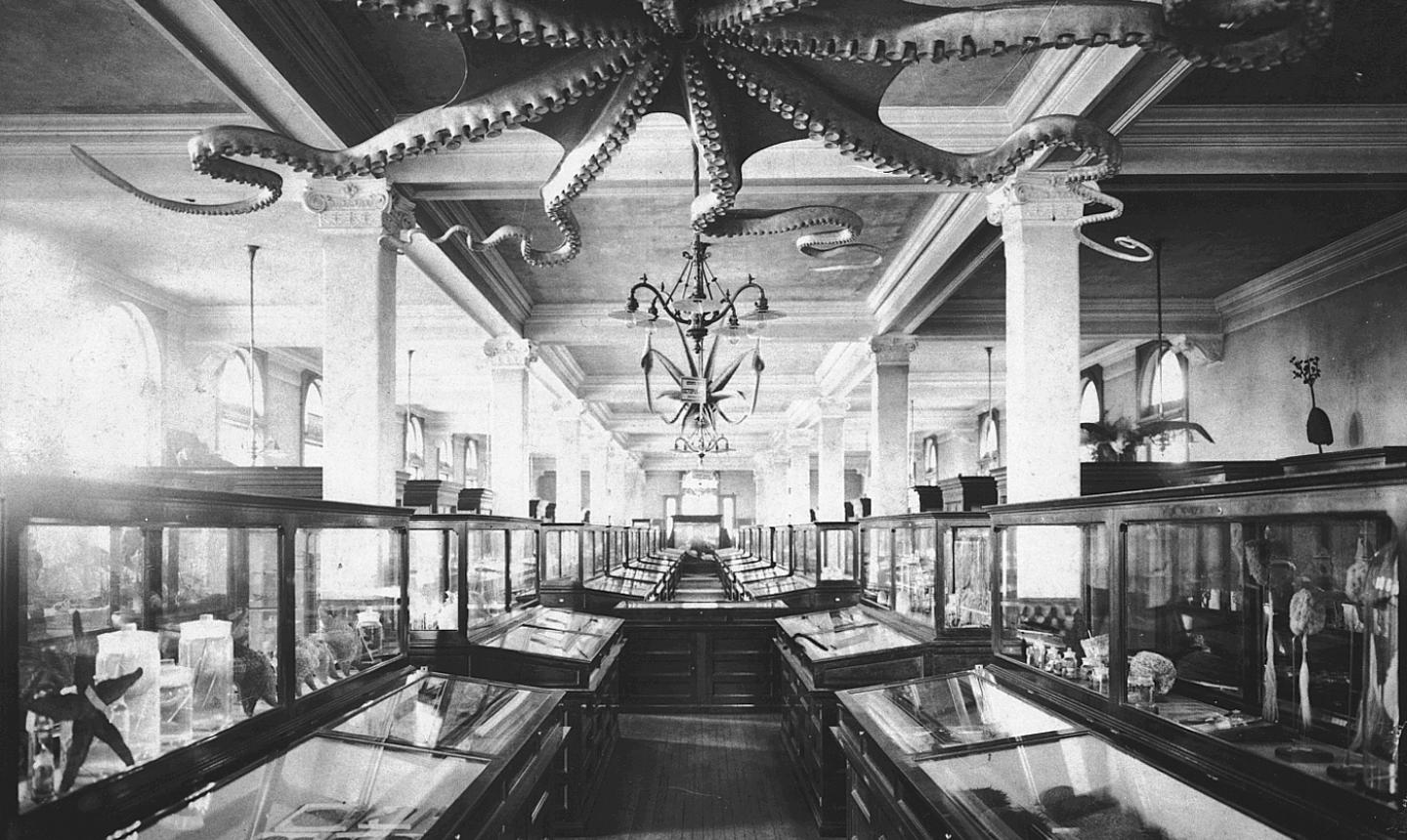
A newly formed Board of Trustees hired the first director Carl Doerflinger, and an assistant, rented nearly 3,000 feet of space for exhibits and offices in the municipal Industrial Exposition Building, and opened the museum to the public on May 24, 1884. Doerflinger resigned in 1888 because of illness but his vision set the future course of the museum in the equal emphasis on the use of collections for study and research and the importance of public education through exhibits. He also helped promote a city bond issue to purchase land and build an imposing neoclassical structure to house both the Public Museum and Public Library that opened in 1898 on what is now Wisconsin Avenue in downtown Milwaukee.
The tradition of innovative exhibits, dubbed "The Milwaukee Style," began with the work of Carl Akeley, the "father" of modern taxidermy who started his career in Milwaukee. Although others had included props and backgrounds in cases holding taxidermy specimens, Akeley's muskrat colony, completed in 1890, is considered the museum world's first total habitat diorama.

Museum-Library building, ca. 1920.
Since Doerflinger's first two successors had concentrated on the natural sciences, the fourth director Henry L. Ward, hired in 1902, made a case for funding a "History Museum". Completed in 1912, it was, in fact, a seamless addition to the original structure as Ward intended exhibits to integrate natural and human history. In 1909 he hired Samuel A. Barrett who had received the first doctorate in anthropology awarded by the University of California the previous year to help develop his plans as head of a joint anthropology-history department. Barrett succeeded Ward in 1920 and in addition to continuing his programs encouraged systematic field research by teams of scientists and artists for exhibit planning as well as scientific collecting. His most ambitious project was the Cudahy-Massee Milwaukee Public Museum Africa Expedition of 1928-1929 that included himself as ethnologist and photographer. While work on the African materials got under way, the Great Depression of the 1930s set in, threatening the future of the museum. Barrett proved highly creative in using the WPA and other "New Deal" programs that not only kept the museum going but allowed him to develop special projects that created employment for many people beyond the basic staff.
When Barrett retired in 1940, Will C. McKern who had headed the anthropology-history section since 1925 accepted the directorship in 1943 upon the unexpected death of Barrett's successor, Ira Edwards, head of the geology section. McKern instituted a Friends of the Museum (FOM) organization to help raise funds, and reactivated plans that had been shelved during World War II, particularly the drive for a separate museum building for which an architectural plan was prepared in 1948. He delayed his retirement until a city bond issue for a new building finally was approved in 1958. Because of differences of opinion about a successor from the senior staff, the Trustees called for a city Civil Service exam that was then advertised nationally.
The finalist, Stephen Borhegyi, a naturalized American from Hungary, was the director of the Stovall museum at the University of Oklahoma and a professor of Anthropology. When Borhegyi took office in 1959 he faced dissension about the 1948 building plan that he and the staff considered outdated and the city deemed had become too costly to construct. He sought input from colleagues throughout the museum profession and met with the staff to revise plans. Begun in the fall of 1960 the building was completed in late 1962. It is located a block north of the old Museum-Library building where exhibits remained open to the public until 1966. Virtually the whole city felt a sense of personal loss on September 26, 1969 when Borhegyi was killed instantly in an automobile accident near the museum.
When anthropologist Kenneth Starr from the Field Museum became the director in 1970, he turned his attention to matters that had been neglected or postponed in the initial rush to build exhibits. Starr sought department heads and assistant curators with full academic qualifications as positions opened through retirement of largely self-trained curators, and he created new positions such as registrar and conservator to bring the the Museum into line with current museum standards. When admittance fees to the museum for non-city residents were instituted in 1972, controversy arose and after extensive negotiations jurisdiction over the museum was transferred from the City of Milwaukee to Milwaukee County in 1976.
Starr retired in 1987 and delays in finding a replacement exacerbated difficulties in developing effective working relationships between the museum and the county. When Barry Rosen, a historian who headed the New Jersey Historical Society, became the director in 1988, he made reorganization a top priority whereby the museum was separately incorporated to facilitate its own fund raising in partnership with the county that continues to contribute to the museum's support and holds the building and collections in trust for the people of the county.
Rosen was succeeded in 1995 by William Moynihan, assistant director of the American Museum of Natural History in New York, and served until 2001. During his tenure a wing was added to the front of the building for a butterfly garden featuring live butterflies and new environmental exhibits were opened.
The last five years have seen the need for reappraisal and modification of the museum-county partnership. The task, now in progress, is under the direction of Daniel Finley, formerly the County Executive of Waukesha County that neighbors Milwaukee County, who took office as the President and CEO of the museum in 2005.
Prepared by Nancy Oestreich Lurie