History
Colonial Origins
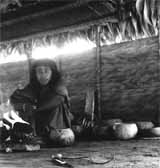
Lacandon Indian burning incense, Chiapas, Mexico
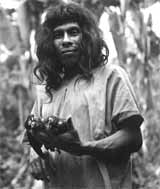
Lacandon Indian, Chiapas, Mexico

The Menominee, an Algonkian-speaking people, are the only present-day tribe in Wisconsin whose origin story indicates they have always lived in Wisconsin. The Menominee refer to themselves as Mamaceqtaw (pronounced ma-ma-chay-tau), meaning "the people." Other Indians called them Menominee (also spelled Menomini), derived from manomin -- an Algonkian word for wild rice -- because it is a major food source for the tribe.
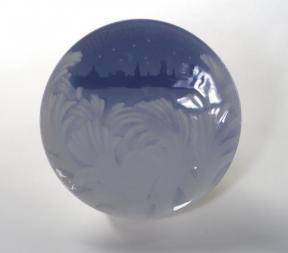
The Danish firm of Bing and Grondahl manufactured their first Christmas plate in 1895. The Christmas plates are intricately designed to reflect an old Danish tradition. Hundreds of years ago, Danish masters would give their servants well-designed Christmas plates and servants would have a competition to try to determine whose master had awarded them with the best plate. Today, Bing and Grondahl have kept the Christmas Plate tradition alive by producing a collectible ceramic plate each year at Christmas. The complete Milwaukee Public Museum collection includes every B&G Christmas plate, the first from 1895, "Behind the Frozen Window," which features the skyline of Copenhagen, to the most recent "Christmas in the Woods," from 2009.
First, when they are extended federal recognition, they can establish tribal governments that possess a measure of sovereignty. Non-recognized tribes can form tribal organizations but lack sovereign powers. Second, federally recognized tribes can have their reservation lands placed in trust. This means that their land is protected by the federal government from being purchased or taken by non-Indians.
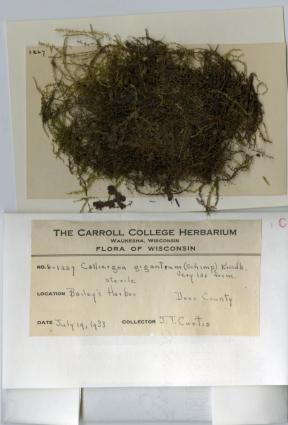
John T. Curtis (1913–1961) was a renowned Wisconsin scientist best known for his contributions to the development of numerical methods in ecology and his seminal book, The Vegetation of Wisconsin: An Ordination of Plant Communities, published 1959. Curtis was born in Waukesha, WI and graduated from Carroll College (now University) in 1937. While an undergraduate at Carroll, Curtis made a substantial collection of bryophytes (mosses and liverworts) from around WI. These specimens have been on permanent loan to MPM for over 30 years and are critical research and comparative tools for understanding the natural history of Wisconsin bryophytes.
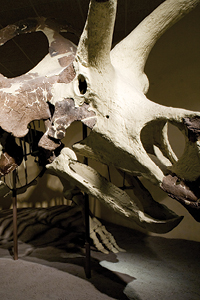 Paleontology is the study of life from the deep past through fossils of plants, animals, and other organisms that lived thousands or millions of years ago.
A fossil is preserved evidence of past life, and can be a body fossil (bone, teeth, leaves, or shells) or a trace fossil (footprints or coprolites, which is fossilized poop!).

Learn about the seasonal availability of edible spring plants in Wisconsin.
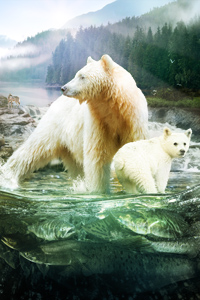 From the outside world, the Great Bear Rainforest is a sanctuary to a stunning diversity of wildlife, including the fabled all-white Spirit Bear — the rarest bear on Earth — and the indigenous First Nations people, who have provided stewardship of the forest for millennia. It is the largest temperate coastal rainforest in the world and has remained relatively unchanged for more than 10,000 years. Great Bear Rainforest celebrates a place that could only have thrived through sustained co-existence between humans, land and sea animals, and the natural environment. Narrated by Canadian actor Ryan Reynolds, Great Bear Rainforest is the first time this pristine, wildlife-rich world will be experienced in giant screen theaters.

Presented by: