

Search
Planetarium Newsletter - September 2024
*/
/*-->*/
Cosmic Curiosities
“There wouldn’t be a sky full of stars if we were all meant to wish on the same
Potawatomi
Potawatomi Culture
Potawatomi speak a language of the Algonkian language family and have lived in the Great Lakes region for at least four centuries. Throughout their history, the Potawatomi have moved and been moved many times, but their aboriginal territory was in Michigan’s lower peninsula. Oral traditions of the Potawatomi, Ojibwe, and Ottawa assert that at one time, all three tribes were one people who lived at the Straits of Mackinac.
Planetarium Newsletter - November 2020
Cosmic Curiosities
“The remarkable thing about Shakespeare is that he is really very good –
in spite of all the people who say he is very good.”
- Robert Graves, 20th-century English writer
Planetarium Newsletter - December 2020
Cosmic Curiosities
“It’s like winning a lottery. Although the odds are astronomical, most weeks, someone hits the jackpot.”
- Stephen Hawking, British Physicist
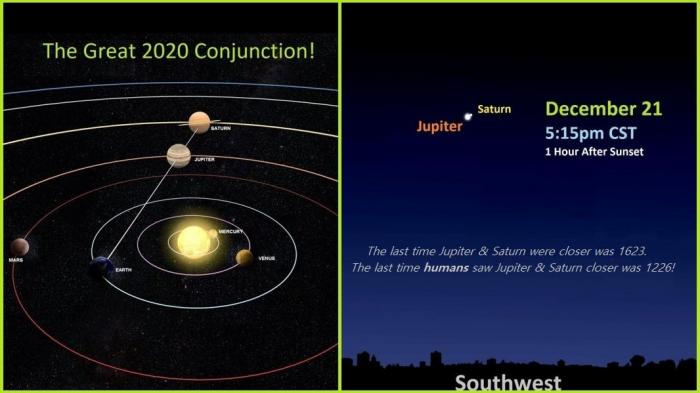
The Great 2020 Conjunction
Planetarium Newsletter - July 2017
Cosmic Curiosities
“I have just gone over my comet computations again, and it is humiliating to perceive how very little more I know than I did seven years ago when I first did this kind of work.”
~ Maria Mitchell, 19th century American Astronomer
Sun and Moon Size -- A Coincidence?
Life Stages
Pregnancy, Birth, and Infancy
The Great Lakes tribes observed specific taboos during pregnancy which extended to both parents. Both expectant parents, but particularly the mother, were warned not to look at deformed animals or people for fear it might harm the child. Eating or looking at turtles or rabbits could cause the baby to develop the jerky motion of a turtle or rabbit-like fits.
Modern Lake Amatitlán
To the Maya of the modern Lake Amatitlán communities, the lake has a longstanding tradition as a sacred place. During Pre-Columbian times, according to legend (see Borhegyi 1959:237-38, Suzanne de Borhegyi 1961), a carved stone figure known as Jefe Dios occupied a hilltop on the north shore of the lake. One night in the 17th century, during a violent hailstorm and earthquake, the figure disappeared. In the morning, the small, painted wooden statue of the Santo Niño, the Christ Child, stood at the water's edge at the base of the cliff.