Planetarium Newsletter - May 2019
Cosmic Curiosities
“Every book is its own black hole. Don’t fight the pull; find out where it takes you.”
- Richelle E. Goodrich, American Writer
Shedding Light on the Black Hole


“Every book is its own black hole. Don’t fight the pull; find out where it takes you.”
- Richelle E. Goodrich, American Writer
“The universe has a history; this is probably the greatest discovery of our century.”
~ Hubert Reeves
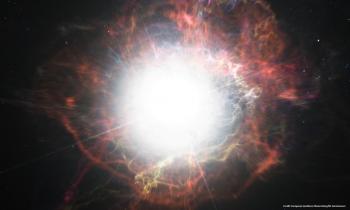 A sort-of supernova—that’s a zombie star.
The beings that make up Kwakiutl mythology are remarkably diverse. Accounts of their interactions with humans and each other are passed along through stories that not only form the basis of traditional Kwakiutl spiritual and ceremonial life and lore, but also connect Kwakiutl families to their ancestral pasts. Many contemporary Kwakiutl identify themselves as Christians but incorporate traditional mythology into their faith, freely blending elements of Christian and indigenous religion.
The Oneida Tribe are members of the League of the Iroquois, a confederacy of the Seneca, Cayuga, Onondaga, Oneida, and Mohawk based on mutual non-aggression. At a later date, the Tuscarora joined the Confederacy. The Oneida’s traditional territory is in upstate New York. The Oneida refer to themselves as Oneyoteaka, "People of the Standing Stone." According to Oneida traditions, there was always a large, red boulder near the main Oneida village.
Potawatomi speak a language of the Algonkian language family and have lived in the Great Lakes region for at least four centuries. Throughout their history, the Potawatomi have moved and been moved many times, but their aboriginal territory was in Michigan’s lower peninsula. Oral traditions of the Potawatomi, Ojibwe, and Ottawa assert that at one time, all three tribes were one people who lived at the Straits of Mackinac.
The Ojibwe speak a language of the Algonkian language family and constitute the largest Indian group north of Mexico. Their extensive pre-contact territory in Canada was mainly north of Lakes Superior and Huron. During historic times, they spread west and south and, today, numerous Ojibwe bands stretch from present-day Ontario in eastern Canada all the way into Montana.