
Search
MPM Giving Day
 MPM Giving Day
Thursday, March 12, 2026
Thank you to everyone for supporting the Milwaukee Public Museum during Giving Day 2026. Throughout the day, donors from across our city, state, and beyond showed remarkable generosity.
Member Appreciation Celebration
*/
/*-->*/
Member Appreciation Celebration
Member Appreciation Celebration 2026 coming soon
We love our members! Your support enables MPM to serve half a million visitors each year. It allows us to care for more than 4 million collection objects. And, it increases community access to Museum programs and events. Thank you for everything you do. Members enjoy special perks during our Member Appreciation Celebration as a token of our appreciation.
Zoology
MPM's Zoology collections are the largest in the Museum's care.
The Invertebrate Zoology collection contains approximately 800,000 specimens, of which 70% are insects, and the Vertebrate Zoology collection contains more than 1.8 million specimens, including fishes, amphibians, reptiles, birds, and mammals.
Please Note:
In preparation for the upcoming collections move, we have adjusted our access policies:
Planetarium
Welcome to the Universe!
The Daniel M. Soref Planetarium is Wisconsin's largest and most modern planetarium, located at the Milwaukee Public Museum in the same theater as the IMAX®!
60661.71
This is the blacksmith who lives at Char, one of the subdivisions of Warwar. He has his small bag on his left shoulder. In it he has a little duiker horn (type of antelope) filled with medicine hanging around his neck. The cap he is wearing is a cap that is becoming very common now in Mambila. Traders sell these hats for a few cents. Nigeria, Adamawa Province, Warwar.

Catalog Number
60661.71
Planetarium Newsletter - November 2018
Cosmic Curiosities
“I think you should always bear in mind that entropy is not on your side.”
- Elon Musk
Planetarium Education Programs
We are excited to offer classrooms the opportunity to explore the universe virtually!
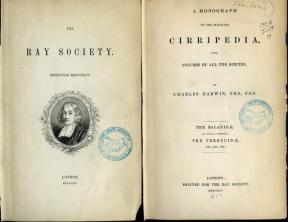
Darwin's "Barnacles" book
This first edition Darwin book, published in 1854, was originally cataloged in the San Francisco Library collection. By good fortune, the book was checked out during the 1906 fire that destroyed the building and made its way to the Milwaukee Public Museum's library a few years later.
The publication of this work not only established Darwin's reputation as a biologist, but as a result of the research, he discovered that barnacles represent a transitional stage between hermaphroditism (individuals with both male and female sex organs) and sexual reproduction. This strengthened an important insight of Darwin's – that sexual reproduction was essential for variation in species – and in natural selection, his central mechanism for evolution.
Item Image
Catalog Number
N/A
42