Planetarium Newsletter - December 2023
*/
/*-->*/
Cosmic Curiosities
“Snow was falling, so much like stars


“Snow was falling, so much like stars
Some of the first archaeological expeditions to Iran began in the mid 19th century, when British and French archaeologists investigated the site of Susa in southwestern Iran. Over the following decades, excavations were predominantly conducted by American, British, French, German, and Iranian sponsored expeditions throughout Iran. Many of these early excavations proved successful in uncovering a wealth of artifacts, architecture, and information pertaining to the ancient civilizations of the region.
“Never have I beheld any spectacle which…so forcibly taught the lesson of humility to man as a total eclipse of the Sun.”
~ James Fennimore Cooper, 19th century American writer
Last Thoughts before the Big American Eclipse
“Antarctica is a paradise compared to Mars.”
- Sandra Faber, American Astrophysicist
John Baptiste DuBay is believed to have been born July 10, 1810 in Green Bay, Wisconsin. His father was John Louis DuBay, a French-Canadian fur trader from Montreal, rumored to be the first European in Portage County. His mother is thought to be a Menominee woman, possibly the daughter of Chief Pewatenot (Menominee). Little else is known about DuBay until his involvement in the fur trade in his early teens.
Thank you for visiting the Milwaukee Public Museum's (MPM) website and reviewing our Privacy Policy. Your privacy is important to us at the Milwaukee Public Museum. The phrase "Personally Identifiable Information" in this policy refers to information or a collection of information you provide to us through the Internet that uniquely identifies you.
“Three things cannot be long hidden: the sun, the moon, and the truth.”
- Buddha
Two eclipses—one lunar, one solar—are on the horizon, literally—in both definitions of the word.
 Every year, millions of visitors travel by way of fins, flippers, and feet to see one of the seven wonders of the natural world: the Great Barrier Reef – a living treasure trove of biodiversity. There is still so much to learn, and knowledge is the key to understanding more about this living Eden. A thriving metropolis populated by a cast of characters straight out of an adventure novel – heroes, bad guys, sidekicks, lovers, and clowns – they’re all players in this vast underwater drama. Today, a new generation of reef guardians are committed to protecting this marine reserve, making a difference and sharing their knowledge of this extraordinary ecosystem, the beating heart of the reef. Learn how this amazing sanctuary has endured for thousands of years and will continue to do so far into the future.
Showing March 30 - September 26, 2019
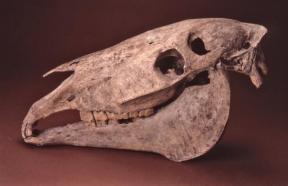
The Spencer Lake site was excavated in 1936 by W. C. McKern, Milwaukee Public Museum Curator of Anthropology at that time. The site is an ancient (AD 1100–1400) burial mound located near Spencer Lake in Burnett County in northwest Wisconsin. At the bottom of the mound, an intact horse skull was discovered, a startling find as it was believed that horses had gone extinct in North America around 10-12 thousand years ago and not reintroduced until the arrival of the Spanish. Two students, upon hearing of the discovery, confessed to placing the skull at the bottom of a pit they had dug into the mound, but McKern and his crew were positive that there was no disturbance of the soils around it.
In 2004, a sample was taken from the skull and sent to two different labs for radiocarbon dating. Both lab results confirmed that the Spencer Lake horse skull was modern, and that the horse had most likely lived during the late eighteenth century or early nineteenth century. (110+/-40 BP; Beta-167209, and 190+/-35 BP; Stafford SR-6189).