

Planetarium Newsletter - March 2026
Cosmic Curiosities
“It was one of those March days when the sun shines hot and the wind blows cold; when it is summer in the light, and winter in the shade.”
- Charles Dickens
Milky Way Fading Fast
One by one, stars slip away.

Credit: Google Earth/Fabio Falchi et al.
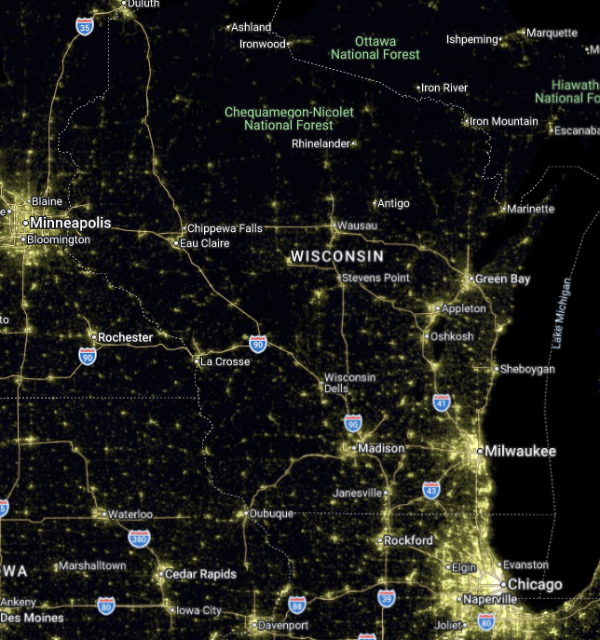
Almost all Americans (99%) experience light pollution. This means we rarely see the ghostly Milky Way arcing high overhead. Meteors—the fleeting “shooting stars”—are hardly seen anymore. To view this magic of the night, most of us drive many miles away from our city lights. Unfortunately, too much of this light is pointed upward (light pollution), or it spreads out in all directions (light glare) where energy and money are simply wasted.
Efforts have been made across the globe to secure proper and efficient lighting. This is seen as a win-win situation. Money is saved as night lights are directed down to where they need to shine. Consequently, more stars can be seen in the sky. Still, new and efficient LED lights scatter more easily in the atmosphere, making the sky brighter every year.
Besides affecting the science of astronomy and simple stargazing, other detrimental effects of increasing light include the impact on human health and wildlife. It disrupts the cyclical changes from sunlight to starlight that biological systems have evolved over millions of years.
Credit: National Park Service
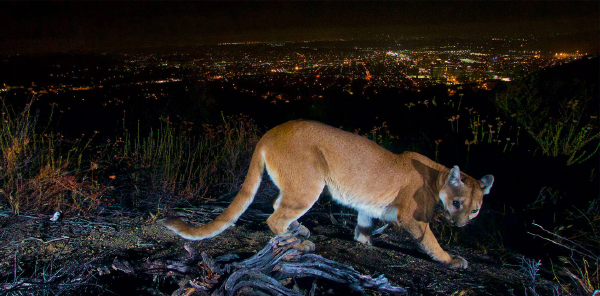
Motion sensor cameras often catch animals unaware and interrupt their natural instincts. This mountain lion was photographed with a motion sensor camera in the Verdugo Mountains near Los Angeles.
Furthermore, the loss of visible stars is a poignant loss of human cultural heritage. Until relatively recent times, humans throughout history had an impressive view of the starry night sky, and the effect of this nightly spectacle is evident in ancient cultures, from the myths it inspired to the structures that were built in alignment with celestial bodies.
Currently, the Federal Communications Commission (FCC) is reviewing two proposals that would spoil a starry night sky even more.
The first proposal comes from Reflect Orbital. They intend to deploy satellites with space mirrors that would reflect the sun's light back to Earth at night. This could extend daylight for solar power arrays and be sold to governments to illuminate streets.
SpaceX is trying to get permission from the FCC to launch up to a million satellites. They are listed as orbital data centers that would be an expansion of its artificial intelligence network. Currently, there are around 14,500 active satellites. If approved by the FCC, this would be a stunning upsurge with negative effects on observing the cosmos. For more information on these satellites and what you can do, contact Dark Sky International, the leading global non-profit organization dedicated to combating light pollution, protecting the nighttime environment, and preserving dark skies for present and future generations. It was formerly known as the International Dark-Sky Association.
Credit: Esri / HERE / Garmin / FAO / NOAA; source: Airbus / USGS / NGA / NASA / CGIAR / NLS / OS / NMA / Geodatastyrelsen / GSA / GSI / GIS User Community
If you are wondering about the best locations for dark stargazing, we recommend Door County or far northern Wisconsin. Also, remember the moon can act like bright city lights, so pick a night when the moon goes to bed early or comes up late.
A New Telescope
A new space observatory will soon be joining Hubble, JWST, and SPHEREx up in the stars!
Credit: NASA Goddard
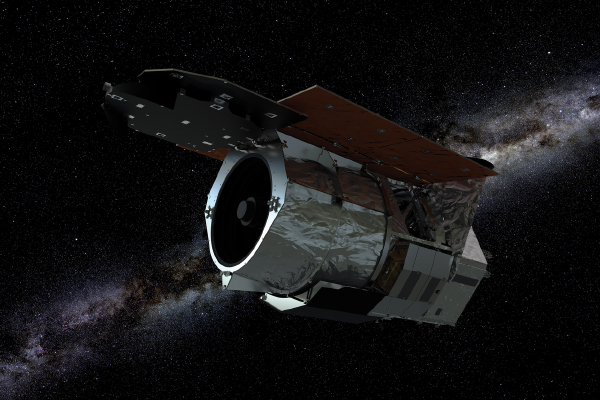
Originally called the Wide Field Infrared Survey Telescope, the Nancy Grace Roman Space Telescope's construction was completed on November 25, 2025. It will soon be boxed up and moved to NASA's Kennedy Space Center in Florida for launch preparations. It could rocket into space as early as September 2026 or as late as May 2027.
Roman is an infrared telescope with a 2.4-meter (7.9-foot) mirror and two instruments, the Wide Field and the Coronagraph Instruments. The coronagraph can block out a star's light to see exoplanets and distant solar systems in formation. Roman will help us complete an exoplanet census, image nearby exoplanets and analyze the composition of their atmospheres. Currently, we have found 6,107 exoplanets.

Credit: NASA Goddard
Roman is slated to detect primordial black holes and study the mysterious dark energy. This unexplained pressure is speeding up the universe's expansion. Once Roman is in space, it will orbit at the Sun-Earth Lagrange Point L2. This is the same location as its colleague, the James Webb Space Telescope (JWST).
Like JWST, Hubble, Spitzer, and Chandra, this new space observatory is named for an incredibly important scientist, Dr. Nancy Grace Roman, the first female executive at NASA, serving as the Chief of Astronomy and other roles throughout the 1960s and '70s. She had a foundational role in planning Hubble as well as ensuring its funding by Congress, gaining the honorary title of “the mother of Hubble” for her efforts. Through Hubble's data, scientists confirmed that the expansion of our universe is accelerating, leading to the discovery of dark energy, which Roman later deemed to be its most fascinating discoveries.
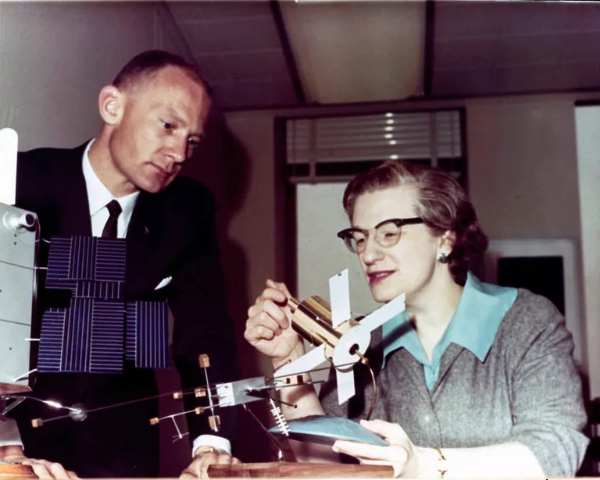
Nancy Grace Roman, NASA's first chief astronomer, explains the Advanced Orbiting Solar Observatory to astronaut Buzz Aldrin in 1965; credit: NASA.
You may be wondering why we need another space observatory? Well, science is an inherently collaborative endeavor, and no single spacecraft can achieve every individual goal of ground-based researchers. Hubble and JWST were both designed to zoom in on objects of interest after they were identified. But the Roman Space Telescope will utilize a much larger field of view, observing far wider frames of the sky and interesting objects in a more efficient manner.
The Roman telescope infrared observations will be complimented by the ground-based Vera Rubin Observatory's in Chile. This pioneering digital telescope, which released its first images in June 2025, is also named for a pioneering female astronomer.
Spring Starts!
It is coming: Spring starts on March 20 at 9:46 a.m. CDT. And do not forget to “spring ahead” (and lose an hour of sleep) on Sunday, March 8—or Saturday night, March 7.
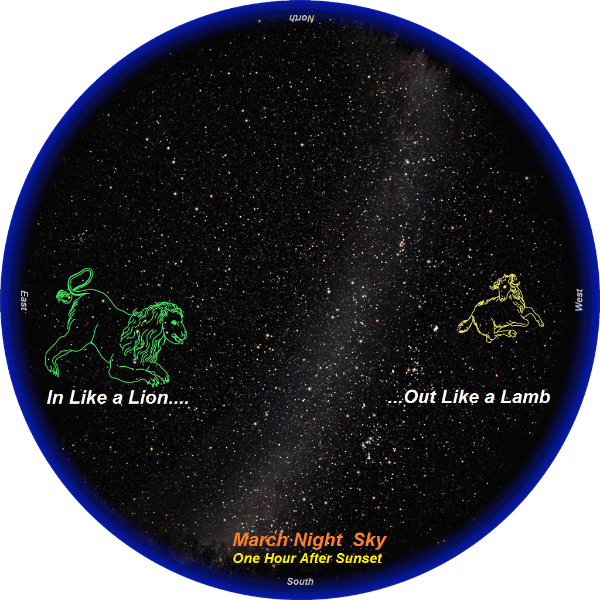
March has lots of changes—and in the sky, too! You may have heard of the expression, "March comes in like a lion and goes out like a lamb." The origin of this lion-and-lamb maxim may come from a couple of constellations above. If you step outside and look east in early March, you can easily spot Leo the Lion, looking like a backwards question mark.
Jocelyn Bell, co-discoverer of the first pulsar in 1967
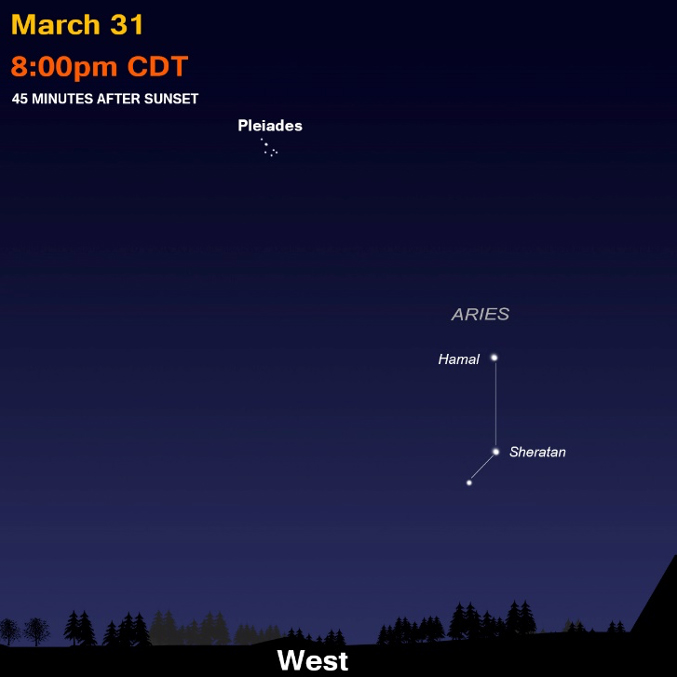
Directly opposite in the western sky, you can catch Aries the Ram, or lamb. Look below the Pleiades star cluster and discover two fairly bright stars, Hamal and Sheratan. By March 31, Aries will disappear quickly in the west after sunset.
Weather and the amount of daylight change drastically in March. It starts with lots of snow potential and is somewhat cold. The average high temperature is close to 40 degrees Fahrenheit. Daylight length for Milwaukee is 11 hours and 13 minutes. By the end of March, it warms up considerably. A few flowers are even starting to bloom. Snow chances lessen. Average high temperature is almost 50 degrees Fahrenheit in southern Wisconsin. Plus, we enjoy more than 12 hours and 41 minutes of daylight—an increase of almost 1.5 hours from March 1!
Space in 60 Seconds
Spot hot, dazzling Venus this spring!
Sky Sights
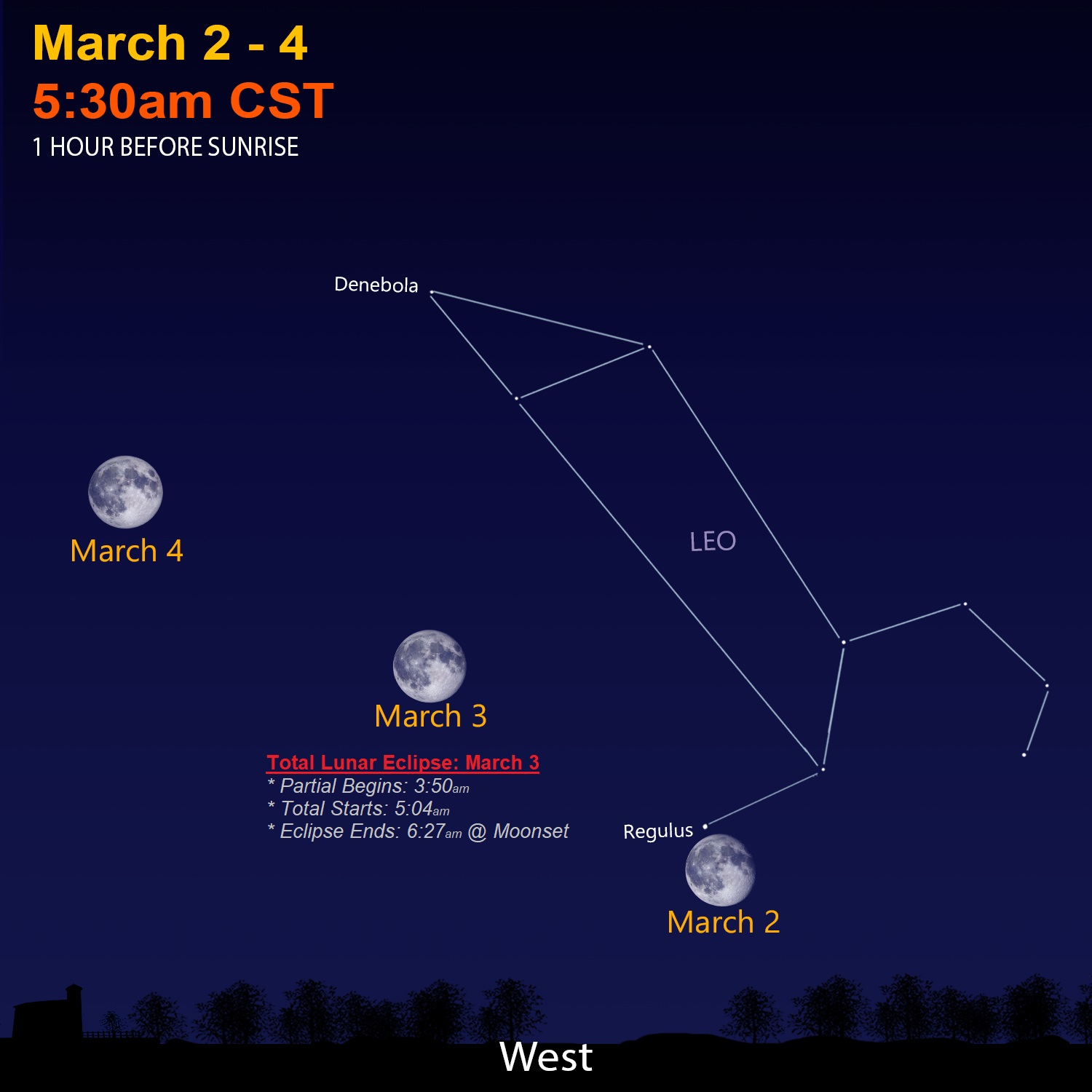
Watch the Moon get eclipsed by the Earth's shadow on Tuesday morning, March 3. Make sure to set your alarm early. Notice the times above in the sky chart! The moon will be low in the west in the constellation of Leo the Lion.
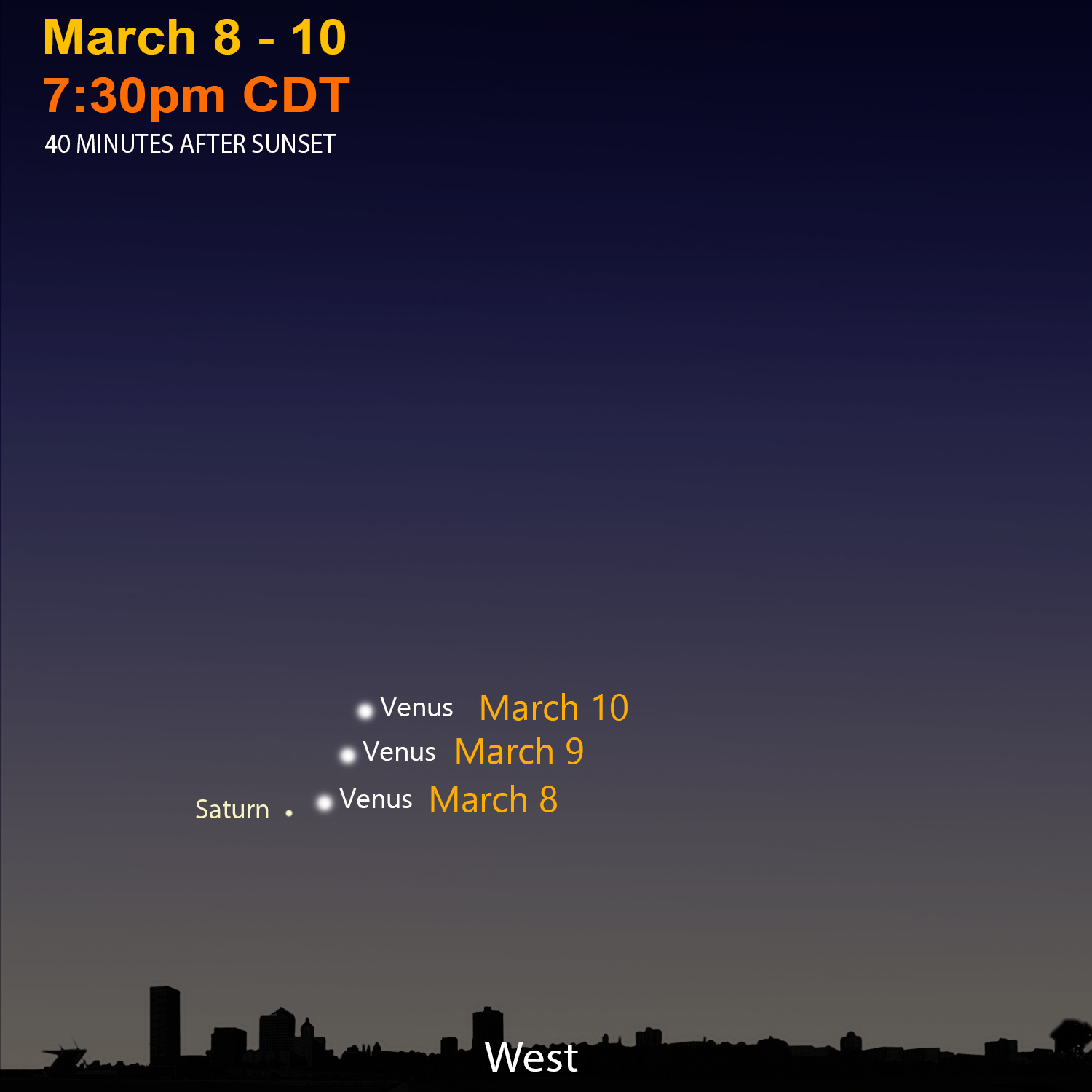
Venus returns! Catch the “#1 reported UFO” low in the west after sunset. It's near Saturn on March 8, but it will be very difficult to see the ringed planet. Venus will continue to climb higher in the western sky while Saturn quickly disappears behind the sun. Saturn will return in the morning sky by early May.
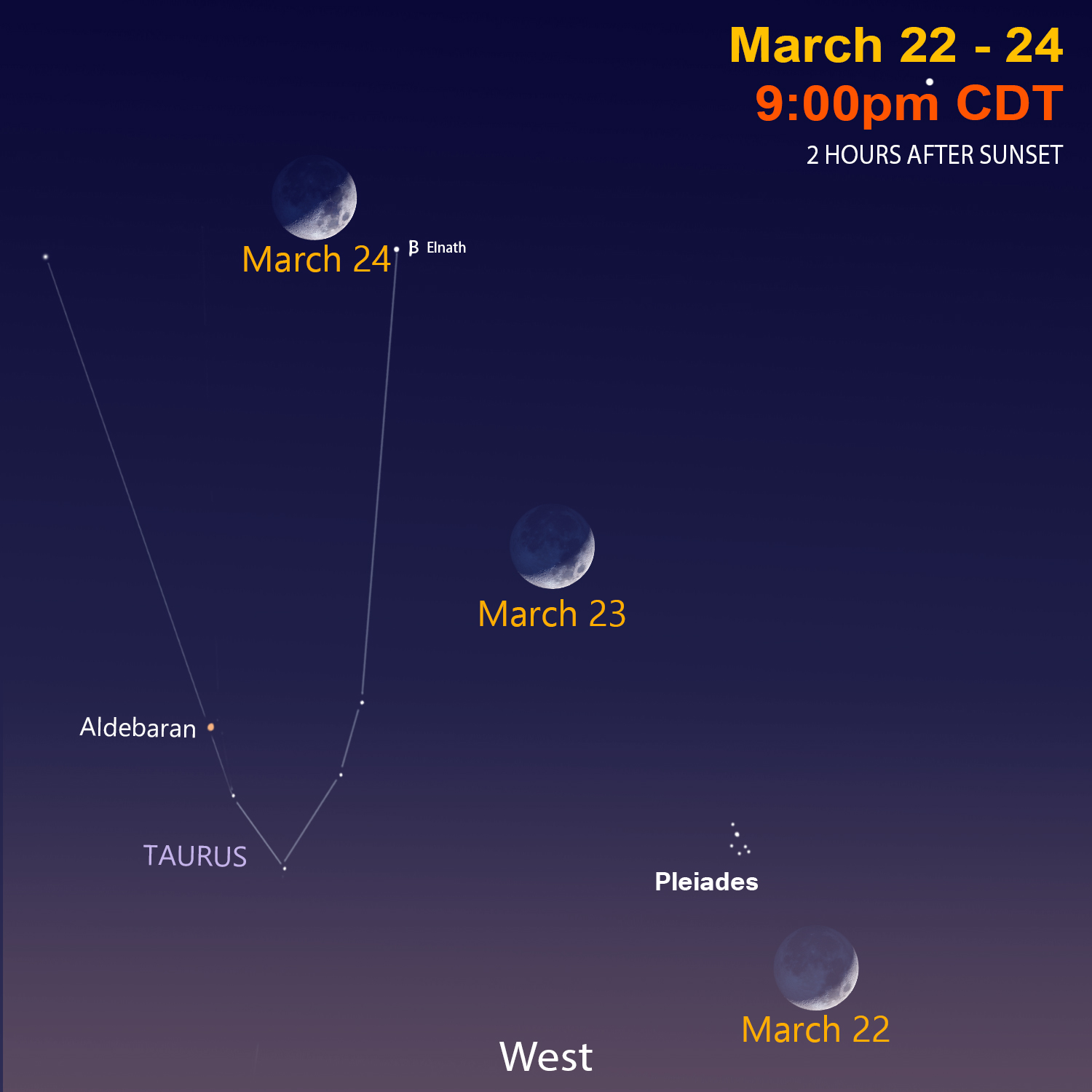
A crescent Moon can be seen near the Pleiades star cluster and the bright red star Aldebaran from March 22 to 24.
Saturn pairs up with the Moon on February 19.
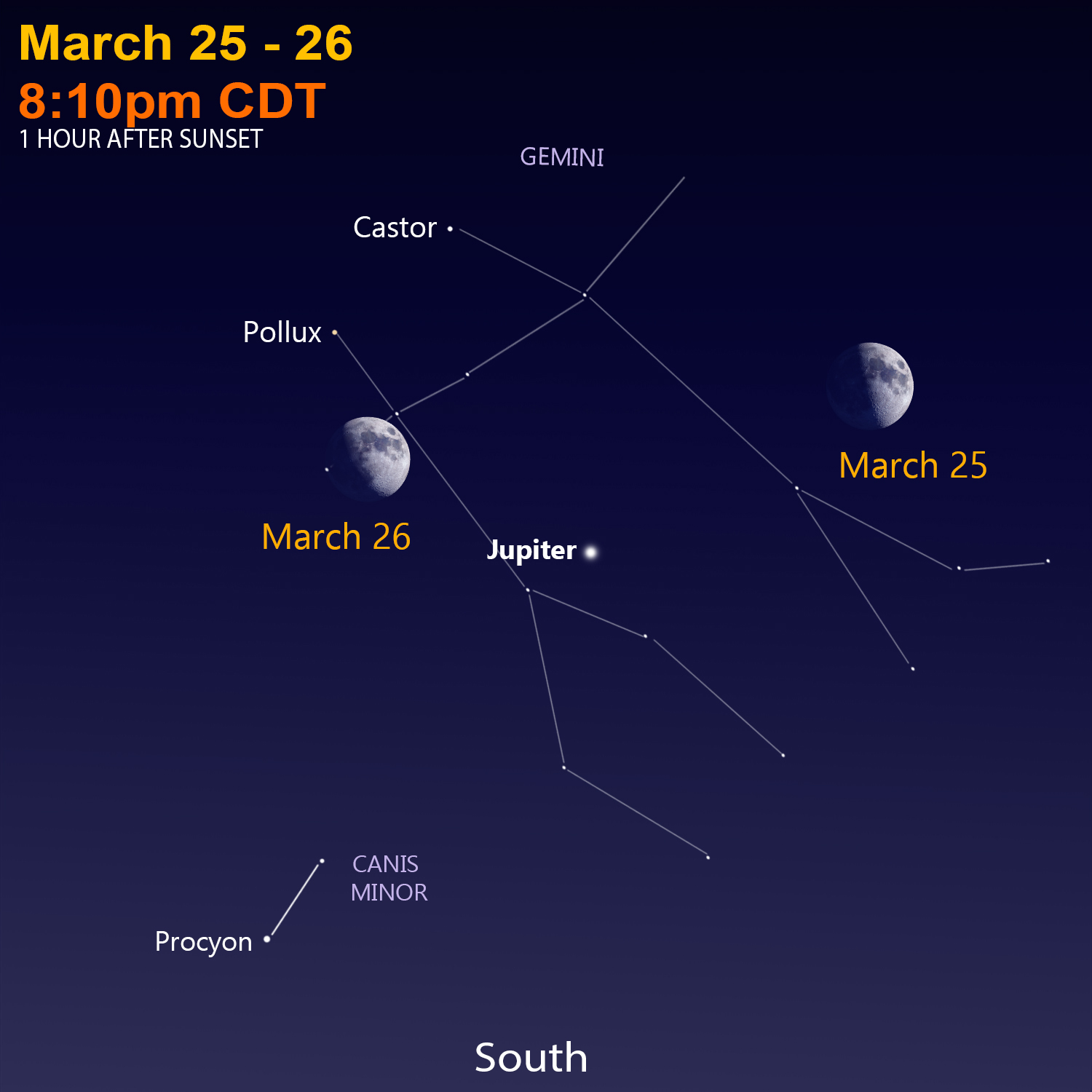
After shining in Taurus the Bull, the Moon moves into Gemini and pairs up with the bright stars Castor and Pollux and brilliant Jupiter on March 25 and 26.
Once again, Mars is still too close to the sun to be seen. We may get to see the red planet in late April and for sure by late May. It will not be visible in the evening sky until the end of 2026!
A quick heads-up: There will be an almost total lunar eclipse on Thursday, August 27. Stay tuned for more details as summer approaches.
March Star Map
Sign Up
Receive this newsletter via email!
Subscribe
See the Universe through a telescope
Join one of the Milwaukee-area astronomy clubs and spot craters on the Moon, the rings of Saturn, the moons of Jupiter, and much more.
Follow Bob on social media
Twitter: @MPMPlanetarium
Facebook: Daniel M. Soref Planetarium