Planetarium Newsletter - November 2019
Cosmic Curiosities
“I will love the light, for it shows me the way;
yet I will love the darkness, for it shows me the stars.”
- Og Mandino, American Author
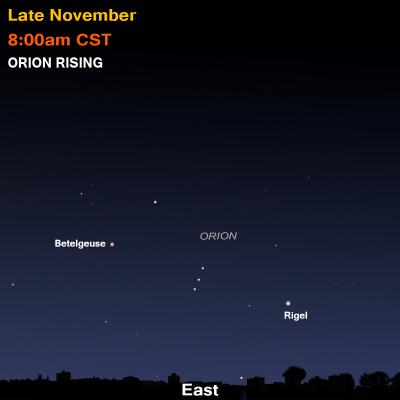
Blue Star, Red Star, Baby Stars


“I will love the light, for it shows me the way;
yet I will love the darkness, for it shows me the stars.”
- Og Mandino, American Author
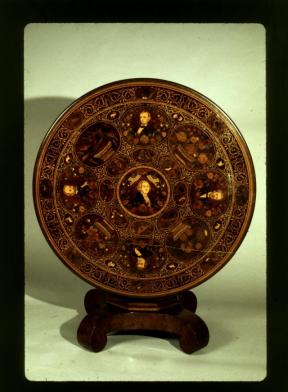
A German immigrant, Peter Glass, crafted wooden tables with extremely intricate wooden veneer designs, which led him to win two major awards -- one at the Massachusetts Charitable Mechanic Association exhibit in 1850 and one from the American Institute of New York in 1856. Shortly thereafter, Glass moved to Sheboygan, Wisconsin and began one of his greatest feats: A table containing nearly 20,000 pieces of wood. This design depicted faces of military and political heroes, with floral motifs. Today, very few Peter Glass Marquetry tables survive. Similar tables crafted by Glass are located at the Smithsonian Institution and the Illinois Governor's Mansion. The table depicted here is on display in The Streets of Old Milwaukee exhibit, but remains covered to protect it from the damaging effects of the lights.
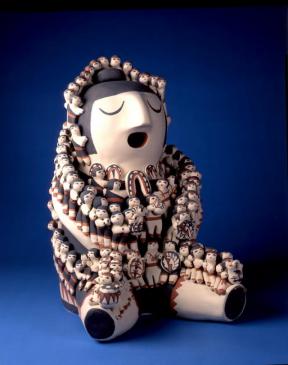
This impressive ceramic storyteller was made by renowned Southwest artist Mary E. Toya of Jemez Pueblo in the early 1980s. At 19 inches tall and with 115 children attached, this is one of the largest and most intricate pieces of its kind. Storyteller figures symbolize the wisdom of elders and illustrate the importance of contact between generations. The value of stories is highly prized by American Indians and oral history is still a means of educating young people in the traditional knowledge and values of their cultures. The Museum acquired this piece in 1997 through the generosity of the late Donald S. Ackerman, his son Mark Ackerman, and his daughter Francine Huxley.
 Grant Park, a unit of the Milwaukee County Park System, is a 381-acre park located at 42.918056 N 87.845982 W. It is a multi-use park with a golf course, tennis courts, soccer fields, and natural areas.
“Time comes into it. Say it. Say it.
The universe is made of stories, not of atoms.”
- Muriel Rukeyser, American Poet
%20Northern%20Lights_0.jpg)
With an innate will to preserve their heritage and a determination to keep out foreign influence, the Kickapoo embarked on a remarkable 250 year migration to their current location just outside the village of Muzquiz in the state of Coahuila, Mexico.
The Wisconsin Oneida are an Iroquoian-speaking Indian tribe currently residing on a reservation in northeastern Wisconsin near Green Bay. They originally came from upstate New York. The Seneca, Cayuga, Onondaga, Oneida, Mohawk, and Tuscarora make up the Six Nations League of the Iroquois. The Oneida refer to themselves as Oneyoteaka -- "People of the Standing Stone." According to Oneida traditions, there was always a large, red boulder near the main Oneida village in New York.
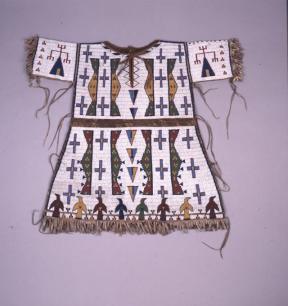
Children's clothing from North American Indian cultures, other than moccasins, is unusual to find in many museums. This little girl's dress is in exceptional condition and is among the earliest items to be cataloged in the Museum.
 Join us for programming 11 a.m. to 3 p.m. on President's Day, February 17 AND our Family Fun Day, February 18!