

Planetarium Newsletter - July 2026
Cosmic Curiosities
Did you stay up last night (the Magi did)
To see the star shower known as Leonid
That once a year by hand or apparatus
Is so mysteriously pelted at us?
- Robert Frost, American Poet
Meteor Dust
Credit: Renaud & Olivier Coppe
These two meteor facts can be confusing:
- An estimated 25 million meteors and meteoroids enter Earth's atmosphere every single day. This daily bombardment equates to about 50 to 100 tons of space material, mostly consisting of tiny dust or sand-sized particles.
- Only one person in recorded history has ever been directly hit by a meteorite.
This data seems contradictory at first glance. If tons of meteors enter our air each day, it seems logical to assume more buildings, cars, and people would be struck. Or at least, more craters should be visible. The key to understanding the contradiction lies in the size of the space rocks and the nature of our planet’s air and surface.
DUST AND SAND
Interplanetary dust particles are extremely small. An estimated average size is 0.001 cm in diameter. How small is that? Calculations say 300 trillion of these dust particles could fit inside a baseball.

Credit: Shutterstock
Grains of sand are bigger that dust, though still tiny.They measure around 0.02 cm and 0.05 cm in diameter. About 2 billion of the smallest grains of sand can fit inside a standard baseball. Around 25,000 of the “large” sand grains can fill a baseball. The smallest grain of sand humans can see with their naked eye is about 0.01 cm in diameter. When a 0.001 cm space dust particle strikes Earth, most do not make a “shooting star.” They avoids the fiery vaporization typical of larger meteors. Instead, air molecules gently slow it down in the upper atmosphere, causing it to melt into a microscopic, spherical droplet before safely settling onto the planet's surface as a micrometeorite.
Scientists estimate tons of this cosmic dust settles onto Earth every day. The invisible micrometeorites slowly drift down through the atmosphere, eventually landing everywhere—oceans, seas, mountains, forests, fields, homes, and even on us humans! So, in a sense, people are constantly being "hit" by extraterrestrial material. No worries, though, these microscopic particles are harmless.
BIGGER SPACE ROCKS
When people talk meteors and meteorites, they usually picture big rocks, not specks of invisible cosmic dust. Depending on how dark your clear night sky is, you can see a faint meteor that is sand-grain size. Brighter meteors can be the size of a pebble. A fireball, a meteor reaching a visual magnitude of -4 or greater, can range from the size of a grape to 6 to 12 feet in diameter.
Source: Russian Television, February 2013
Exceedingly bright meteors are called bolides. They can match or shine brighter than a full moon. These space rocks are over 12 feet in diameter. The one that hit the skies over Chelyabinsk, Russia, in 2013 was estimated to be approximately 60 feet in diameter. Before impacting Earth, this rock would have filled our entire planetarium. As it burned up in the atmomsphere, the impressive bolide was brighter than the sun. Most if the rock vaporized, though some meteorites were discovered.
Although millions of meteors enter the atmosphere every day, almost none survive the journey to become meteorites. There is simply too much speed and friction with the countless air molecules. Their top speeds are between 10 and 40 miles per second! A rock has to be about three feet across—beachball size—so parts might survive and impact Earth as meteorites.
The Earth is bombarded by roughly 40 to 50 meteorites that make it to the ground or ocean each day. The vast majority of these space rocks strike the ocean or uninhabited landmasses. Very few are ever found or recorded by humans. In fact, the Earth’s total surface area is enormous, roughly 200 million square miles. All of today’s humans standing side-by-side would cover only 0.00016% to 0.00078% of its total surface. That is an astoundingly small fraction of our planet’s surface. The odds of a meteorite striking a human are therefore extraordinarily low.
Hopefully, this proves that the two facts above are not contradictory at all. Millions of space particles enter Earth's atmosphere every day. Most are microscopic dust that gently floats unnoticeabale and unfelt. Slightly bigger rocks burn up before reaching the surface. Larger rocks that impact Earth mainly fall in the oceans or uninhabited land.
Breathe easily, everyone!
Lovely, Lethal Venus
Venus is perplexing.
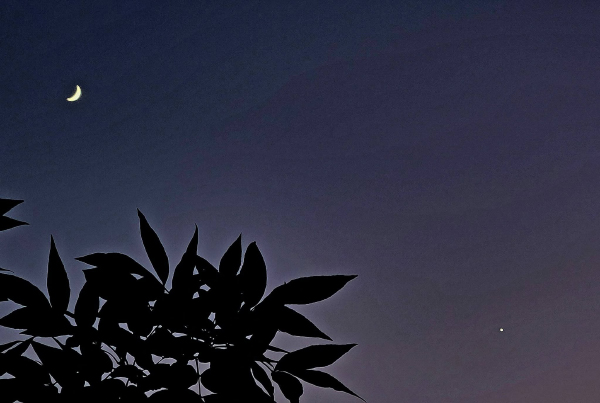
On one hand, its striking brilliance in the night sky is unmatched by other planets and stars. You can see it easily low in the west after sunset this July and August.
On the other hand, Venus up close is a scary, hot, and noxious world.
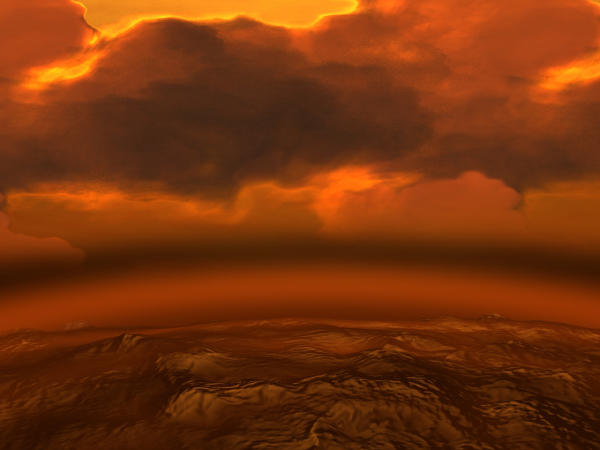
Drawing of Venus Surface; credit: European Space Agency
Like today, long-ago stargazers marveled at Venus and were inspired. Only the Moon outshines Venus at night—and not all the time! When the Moon is a thin crescent, dazzling Venus is brighter and more noticeable. Being so bright, it is prominent in cultural sky records. Without any way to investigate this sky object closer, we can see why Venus becomes a god or goddess with great powers.
In Roman mythology, Venus was the goddess of love and beauty. They borrowed many of these traits from the Greeks, who know her as Aphrodite. The Sumerians’ and Babylonians’ name was Inanna, or Ishtar, where a dual role was cast as goddess of both love and war, residing over birth and death.
Venus was not always seen as a female goddess. To the Maya people, Venus was a feathered serpent god named Kukulkan. He represents not just Venus, but a pantheon of deities.
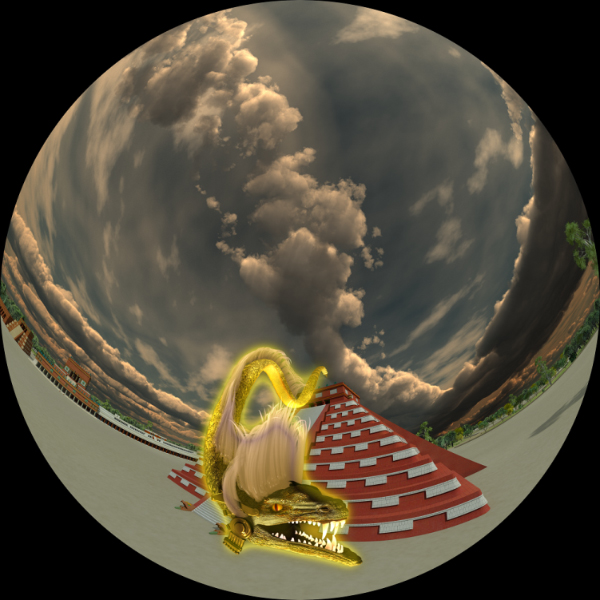
Venus is often called both the morning star and an evening star, depending on its position relative to Earth and sun. Venus can appear before sunrise in the morning or after sunset in the evening. Being closer to the sun than Earth, Venus can never be up all night or reach the top of the sky. Therefore, many cultures saw Venus as two separate gods depending on the time of night.
In 1610, our perception of Venus started to change. The telescope arrived, and Galileo’s observations made him realize that Venus goes through phases like the Moon. This and other discoveries led him to argue the Earth was not the center of the solar system.
After three centuries, telescopes improved dramatically. Still, observations only could glimpse clouds covering the planet. Since no surface features were visible, scientists and science fiction writers imagined all sorts of worlds here, many with fanciful lifeforms. Venus could be covered with one big ocean, swampy and tropical, or even be a hot desert.
Soon astronomers looked beyond visible light to use the infrared part of the electromagnetic spectrum to study Venus. In 1932, infrared studies showed carbon dioxide was the primary composition of the clouds of Venus. Eventually, in the 1950s, observations in the microwave portion of the spectrum led to evidence of high surface temperatures on the planet via the greenhouse effect theory, where carbon dioxide traps the sun’s heat like a greenhouse. Carl Sagan, then a young scientist, led these high temperature theories for Venus.
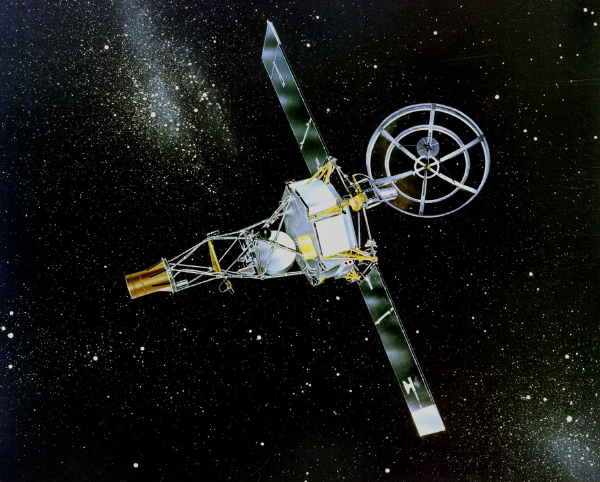
NASA Artist impression of the Mariner 2 spacecraft
Speculations persisted that the clouds of Venus kept it cooler, like here on Earth. Space exploration changed this fantasy starting in 1962 when NASA’s Mariner 2 became the first spacecraft to visit this sweltering world. On December 14, Mariner 2 flew by our neighboring planet, measuring surface temperatures around 400° F and atmospheric pressure at 20 times greater than on Earth’s. Future spacecrafts would measure even higher temperatures and pressures. Today, NASA lists the temperature at 872°F and air pressure at 1,350 pounds per square inch (psi). That amount of pressure is the same as being 3,000 feet underwater on Earth.
NASA has two missions in development that will visit this lovely and lethal world: DAVINCI+ (Deep Atmosphere Venus Investigation of Noble gases, Chemistry, and Imaging) and VERITAS (Venus Emissivity, Radio Science, InSAR, Topography, and Spectroscopy). Each spacecraft is expected to launch in the 2030-2031 timeframe.
Space in 60 Seconds
Follow the planets and moon, and catch a falling star, too—maybe even some fireworks!
Sky Sights
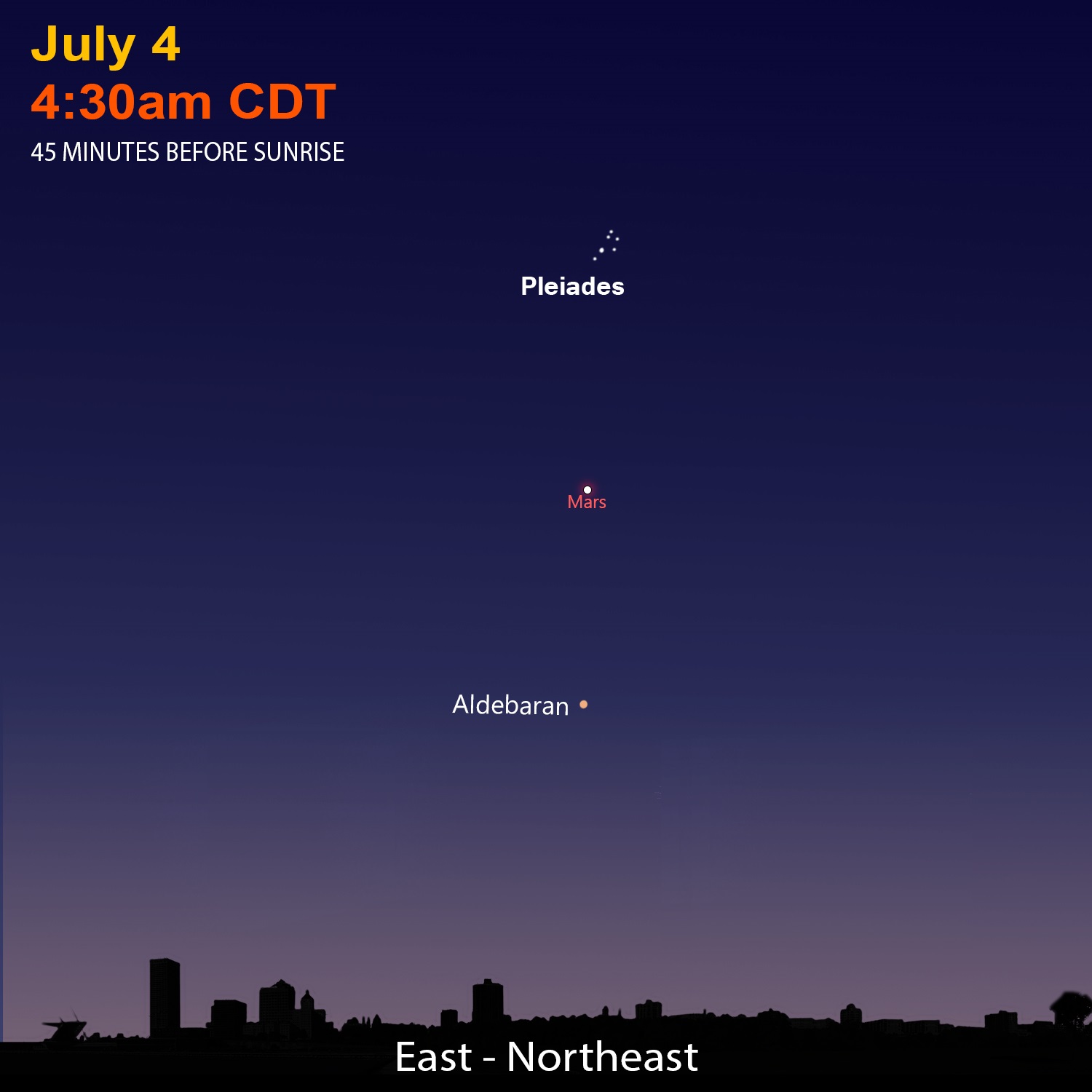
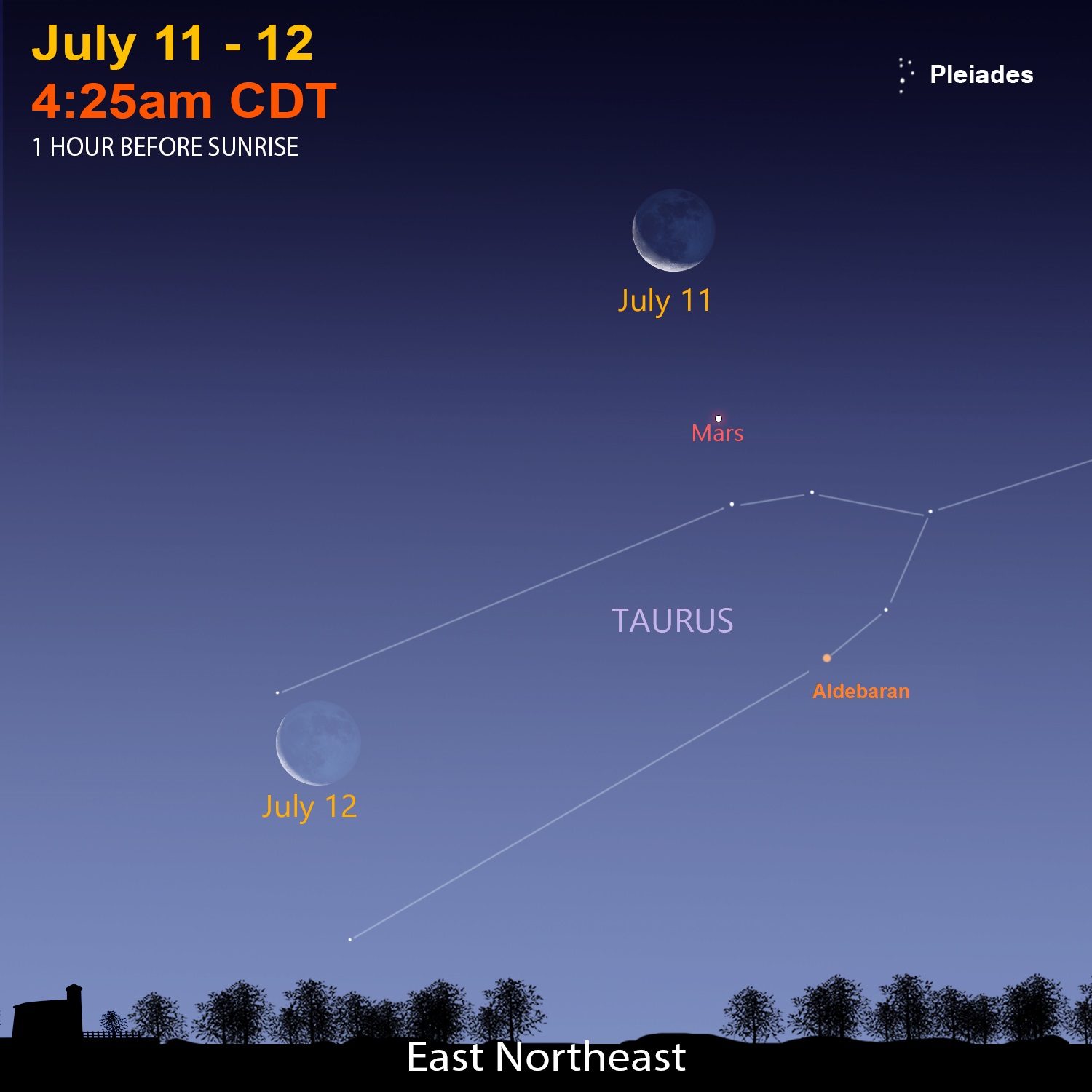
For very early risers, catch the red planet Mars, the red star Aldebaran, and the Pleiades on July 4. Then, on July 11 and 12, use the Moon to spot the red planet and the stars of Taurus the Bull.
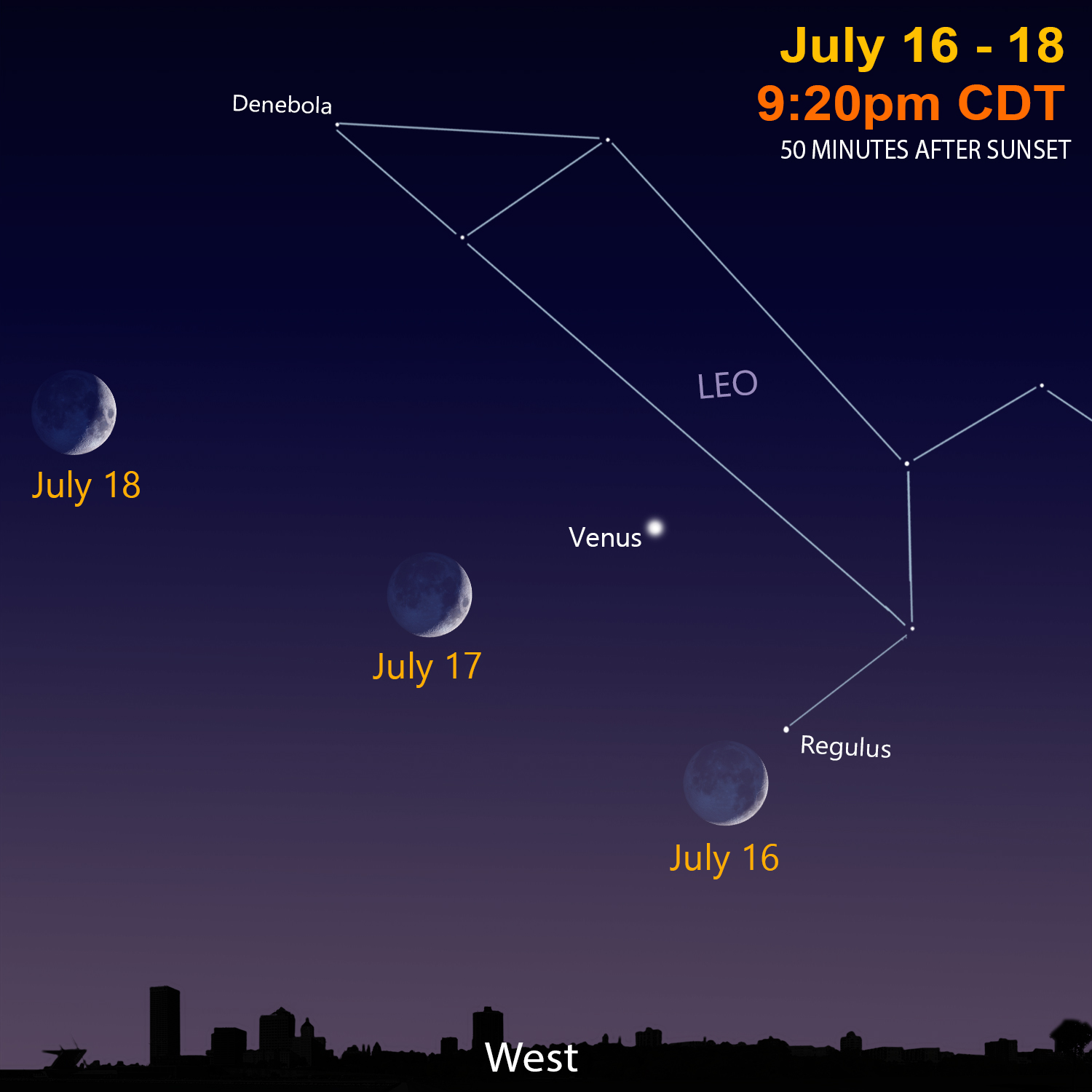
A crescent Moon swings by Venus after sunset in the constellation of Leo the Lion from July 16 to 18.
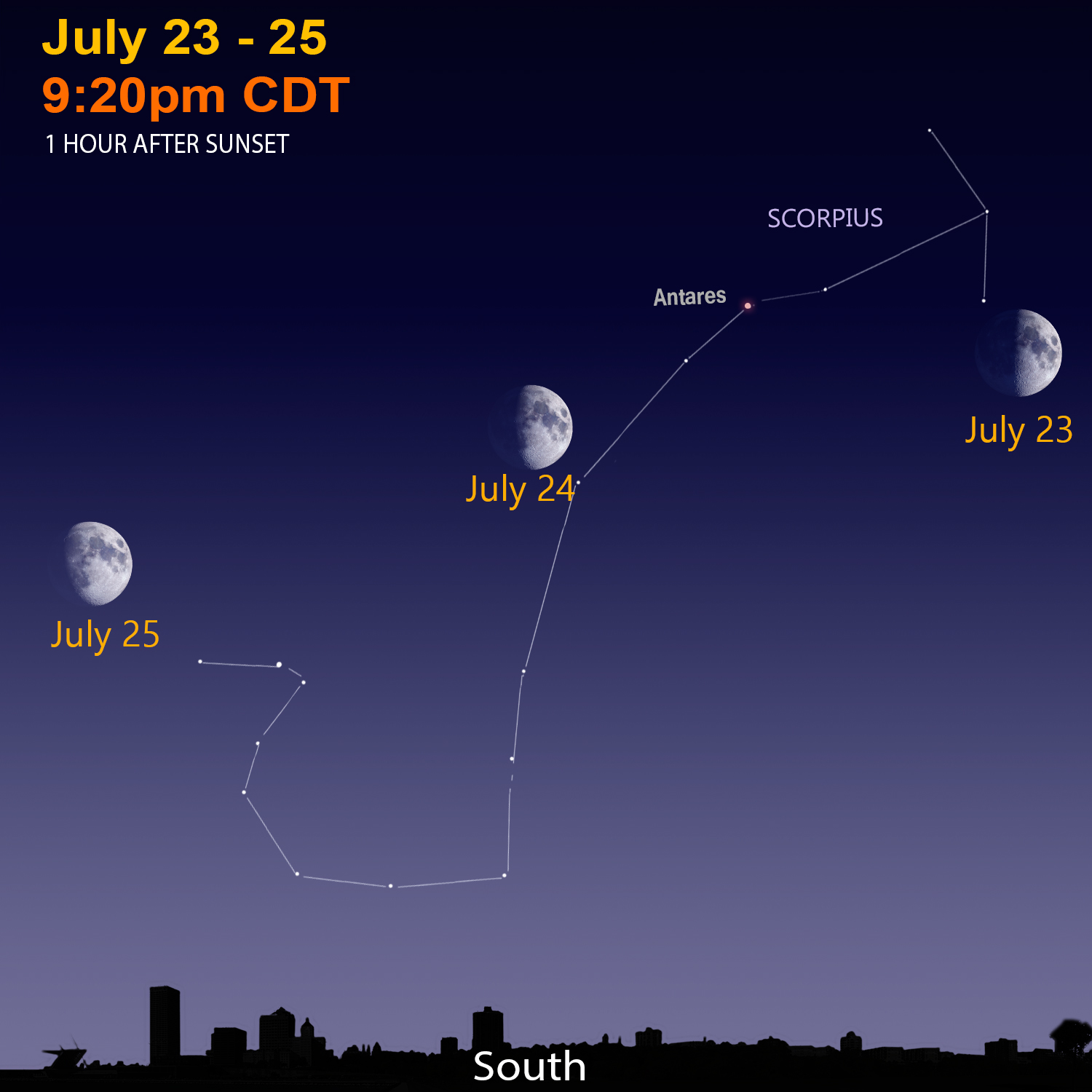
Look for the Moon to visit the stars of Scorpius from July 23 to 25. Look low in the south after sunset. In light speed, the Moon is 1.3 seconds from Earth. The red star Antares is about 600 light years away.
Jupiter is now too close to the sun’s glare to be spotted around mid-July. You will be able to spot it in the morning sky in late August.
Mercury can be seen low in the morning sky toward the end of July.
Saturn and the Moon shine together one hour before sunrise in the southeast from July 7 to 8. Saturn rises at 1 a.m. on July 1 and by 11 p.m. on July 31.
July Star Map
Sign Up
Receive this newsletter via email!
Subscribe
See the Universe through a telescope
Join one of the Milwaukee-area astronomy clubs and spot craters on the Moon, the rings of Saturn, the moons of Jupiter, and much more.
Follow Bob on social media
Twitter: @MPMPlanetarium
Facebook: Daniel M. Soref Planetarium