

Planetarium Newsletter - June 2026
Cosmic Curiosities
“We, this people, on a small and lonely planet
Traveling through casual space
Past aloof stars, across the way of indifferent suns...”
- Maya Angelou, American Poet
Stars in 3D
Space is three dimensional but does not appear that way. The sky above looks 2D, as if the sun, moon, planets, and stars were embedded diamonds on a big, inverted bowl over our heads.
The seven stars of the Big Dipper are not at the same distance from Earth. If they were, the familiar dipper shape would be completely gone. It would look chaotic and random. We might try to make a new 3D constellation! In this video, it might look like a spaceship from a Star Wars movie, or a kite — whatever you imagine.
Credit: StellarPhysicsHub.com
Let’s explore the three bright stars of the Summer Triangle asterism—Altair, Vega, and Deneb. Like the Big Dipper, if we saw them at their actual distance from Earth, they would look very different. Imagine being aboard a spaceship going faster than warp speed. The first star of the triangle we encounter is Altair—the second brightest star of the triangle back on Earth. Its distance is 17 light-years from Earth. Our next destination is Vega, 25 light-years distant. Though it is the brightest star of the triangle, it is farther away than Altair. This tells us Vega is more luminous than Altair. You can think of Vega as a 100-watt star, while Altair is like a 25-watt star. Finally, we head to Deneb, our last stop. Being just a little dimmer than Vega and Altair in Earth’s sky, it should be about the same distance away, right? Maybe 30 light-years distant, or 37?
Deneb’s distance is 2,600 light-years away! This star is super far—and yet, it is bright in our sky. This means Deneb is like a million-watt star. If you made Deneb only 17 light-years away, like Altair, it would shine as bright as the moon. Imagine a star that bright in our night sky!
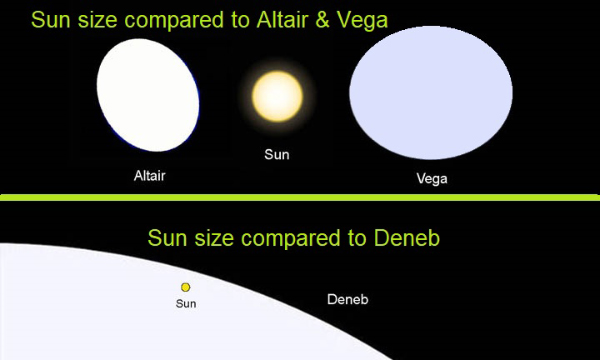
This image shows the size differences between the three summer triangle stars and the sun. Space is very much 3D!
Living in Space
Imagine yourself living in space. Could you do it? What was it like for the Artemis astronauts on their 10-day mission last April? Amazing, but a lot of work? Lonely? Dangerous? How about living on the International Space Station (ISS) for six months, or a three-year trip to Mars? How about a short, 10-minute sub-orbital flight, like some celebrities and the rich have done?
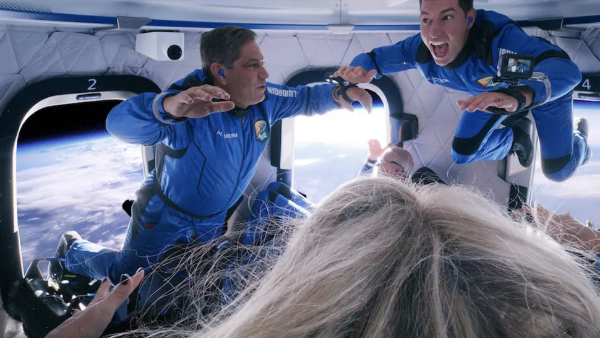
Celebrity Coby Cotton aboard Blue Origin's NS-22 flight on Aug. 4, 2022; credit: Blue Origin
It is understandable if you never think about going to space. “It is too dangerous,” some might say. How dangerous? There have been nearly 800 astronaut trips above our atmosphere. Hundreds have flown more than once. NASA astronauts Jerry Ross and Franklin Chang-Díaz hold the record for flying the most times in space on different missions, with seven flights each. A total of 20 astronauts and cosmonauts have died in spaceflight-related accidents during missions or while attempting to reach space. The success rate is about 97.5%.
We can read space-travel articles and watch videos. But how would you do in space? Speculation for us earthbound beings can be fun and frustrating to think about. We know it is a lot of hard work to become an astronaut. We know they do not look out the window all day and do cool somersaults weightlessly.
So… What is life in space like?
ISS
Astronaut Sunita Williams. Credit: NASA
An astronaut’s day aboard the ISS begins with a breakfast that is rehydrated and cooked in a galley built for use in low gravity. Next is personal hygiene done with a sponge and rinse-less shampoo. Then, there is the first of several blood draws for later medical testing. These continual tests are important because, while exposure to pathogens will be low in space, low gravity causes fluids to rise into the head, giving many astronauts the feeling of a constant low-grade cold. Another reason for all the blood tests is to check for signs of radiation sickness. We sometimes forget that the Earth’s atmosphere and magnetic field shield us from dangerous radiation. Astronauts are highly exposed to this risk.
The next task is testing that the airlocks are secure. Readings are measured to keep the vacuum of space out. Then, exercise: Astronauts are required to do at least two hours of exercise a day to combat muscle and bone deterioration that occurs after weeks without Earth's gravity. Next come meetings with mission control via satellite uplink followed by their assigned experiments. These vary based on the purpose of the expedition. Then, another air and pressure check, lunch, and a one-hour break. These are the times when socializing occurs, that vital defense against homesickness and loneliness.
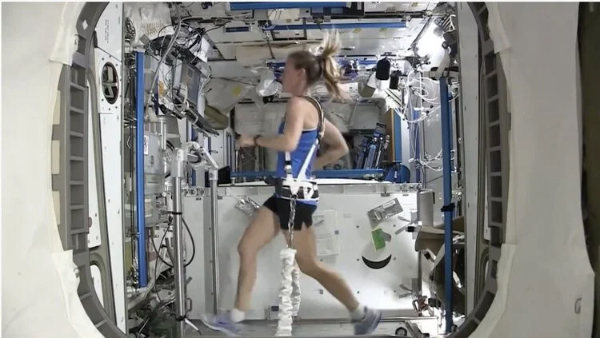
Astronaut Karen Nyberg; credit: NASA
Wrapping up the day is more exercise, more checking of all the various ISS systems, and dinner. After that, it is a planning meeting for tasks coming up, and finally, bed. Astronauts generally work a 16-hour day in space.
Already we can see how life aboard a space station is far from easy and structured at every level around the various challenges faced by those who take on the challenge of living out there. It takes hundreds of dedicated professionals at the height of their skill and dedication to keep just those seven crew members alive and able to do their scientific work.
Muscle degeneration from weightlessness and loss of bone mass from unuse, the claustrophobia of tiny airlocks and tunnels, and the homesickness of being further from home than any human being in history, are only some of the challenges they face.
MARS
Going to Mars—and back—will take longer, about three years. While exciting, it will be an arduous trek. Astronauts will face more enhanced dangers than those on the ISS.
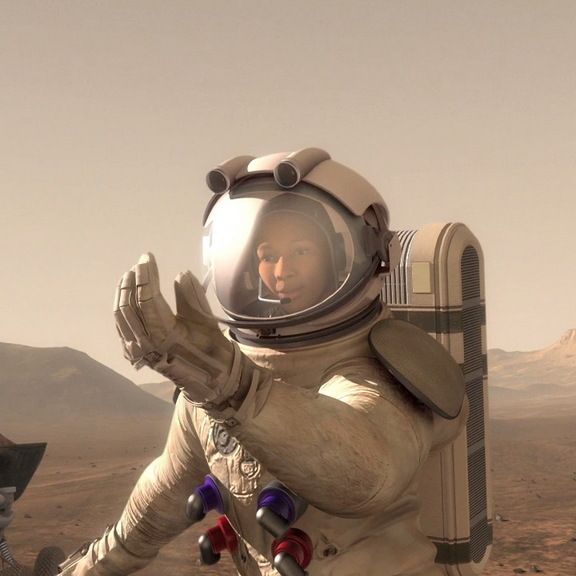
Credit: NASA
There is more cosmic radiation, more extreme isolation, and greater physical effects of microgravity. Astronauts must have strong mental health support because communication with Earth can be more than 20 minutes each way. This delay would require crews to solve emergencies independently.
After arriving on Mars, astronauts will need to set up a base camp. For energy, solar arrays will be deployed. Much more food and supplies will have to be assessed to meet all the provisions for a long stay on the surface. Currently, the best estimates for the first mission will be about 1.5 years on the surface.
Some fun will be involved, as astronauts will be able to bounce more on Mars—the force of gravity is only 38% of Earth. This means if you weighed 100 pounds on Earth, you would weigh 38 pounds on Mars!
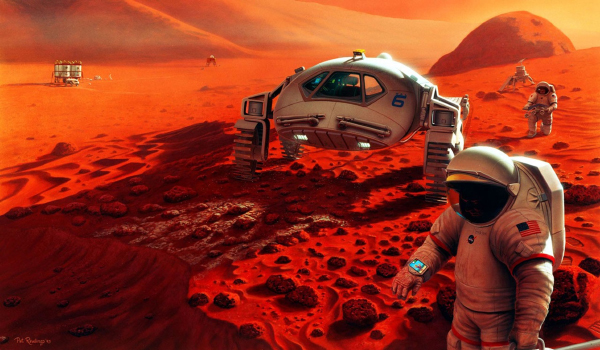
Credit: NASA, Pat Rawlings
Exploring the planet’s surface and collecting scientific samples will be risky for the first humans. Although dangerous and difficult, a Mars mission could expand human knowledge, inspire future generations, and bring humanity closer to becoming a spacefaring civilization.
Space in 60 Seconds
Watch the sun climb to its apex on the summer solstice and two planets almost collide (okay, not really!).
Sky Sights
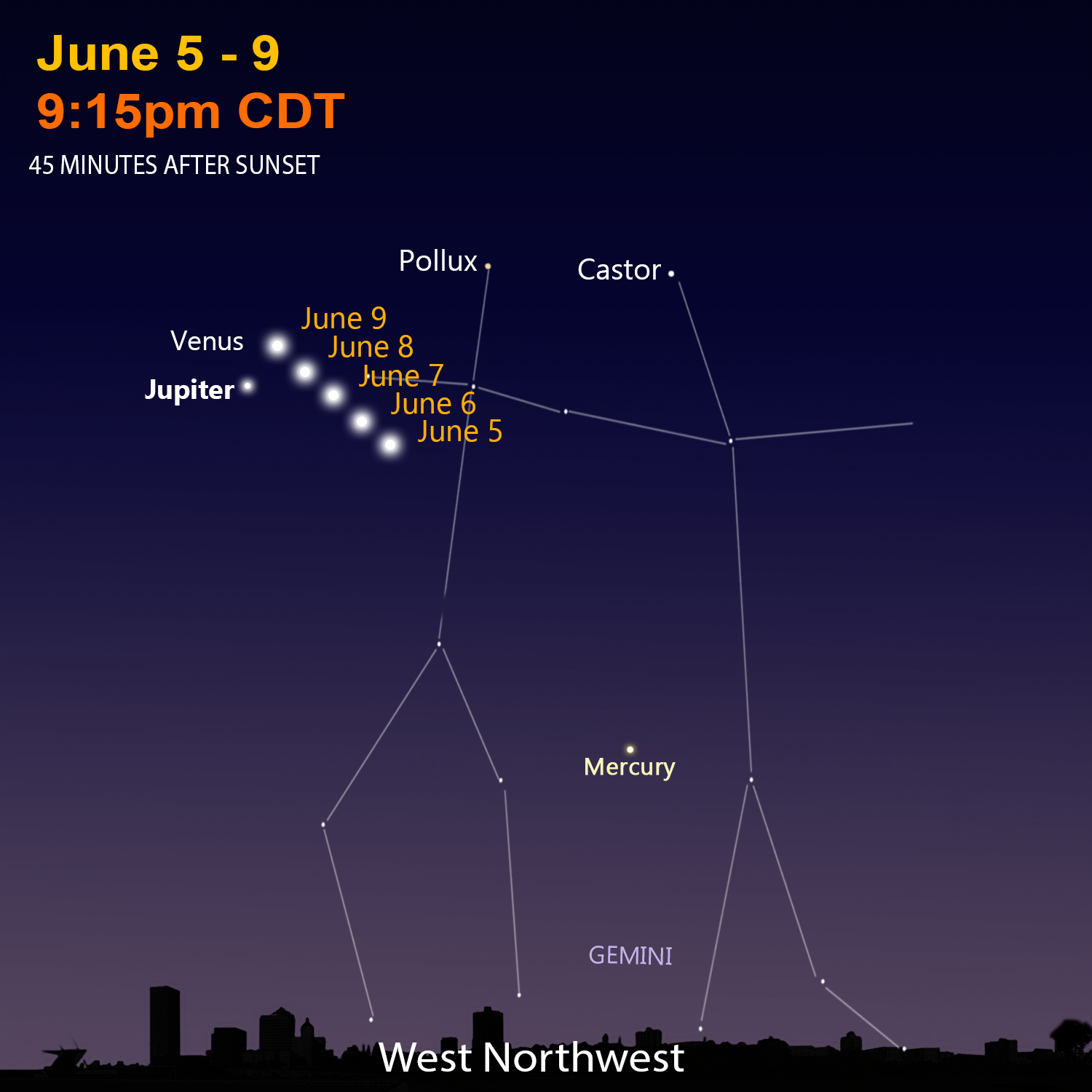
Venus and Jupiter are getting very close! On June 8, they will be 1.7 degrees apart. On June 9, they will be 1.6 degrees apart. Hold your thumb out at arm’s length and you will cover up both planets!
Although most eyes will be on the two brightest planets, try to spot elusive, dimmer Mercury lower in the sky.
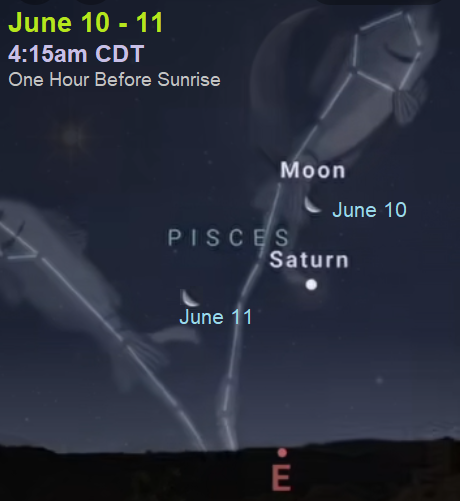
Saturn is higher in the sky and much easier to spot this June. See the ring jewel near Moon on June 10 and 11 in the constellation Pisces.
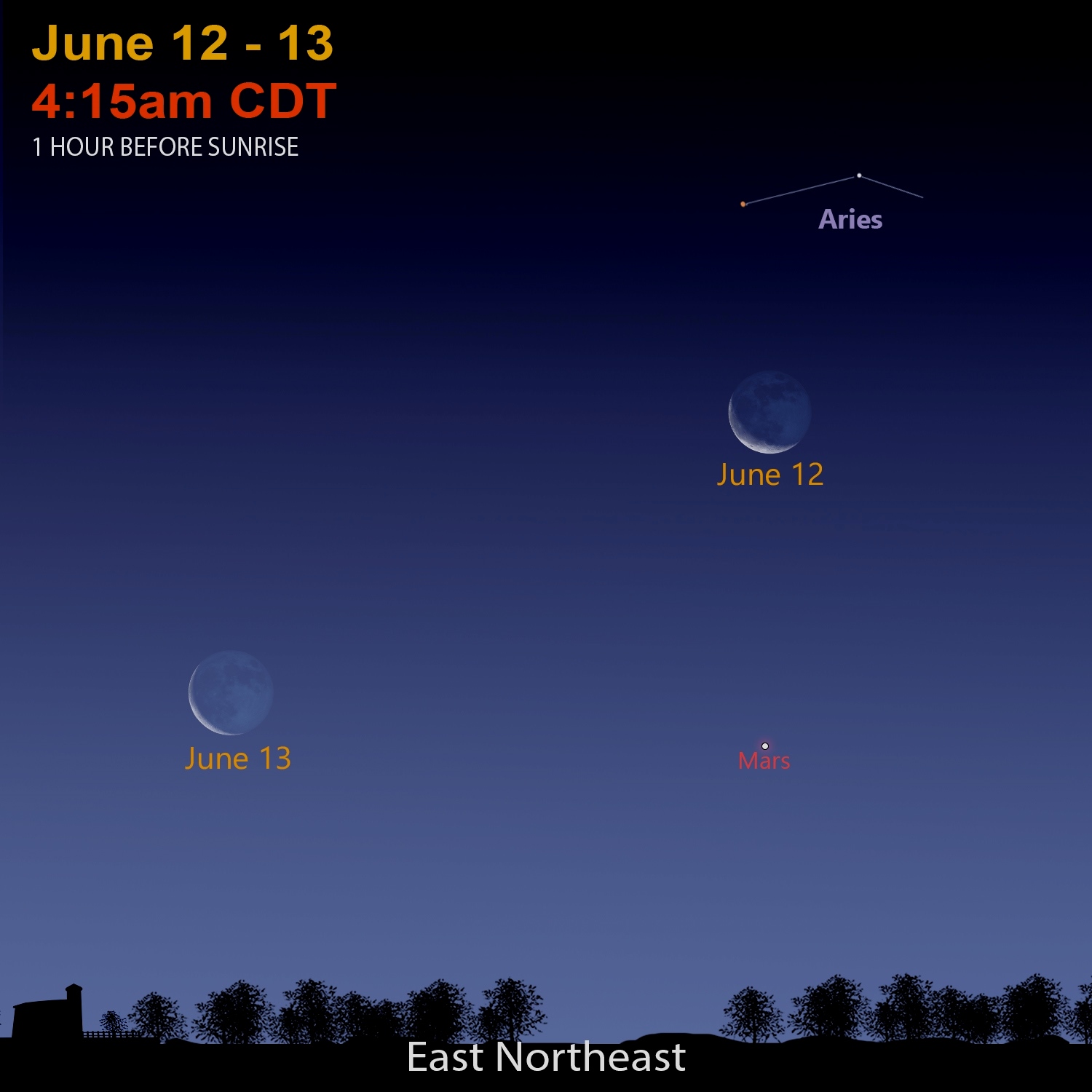
Mars is not very bright, competing with the morning twilight. You can use the Moon to spot the red planet in the very morning skies of June 12 and 13.
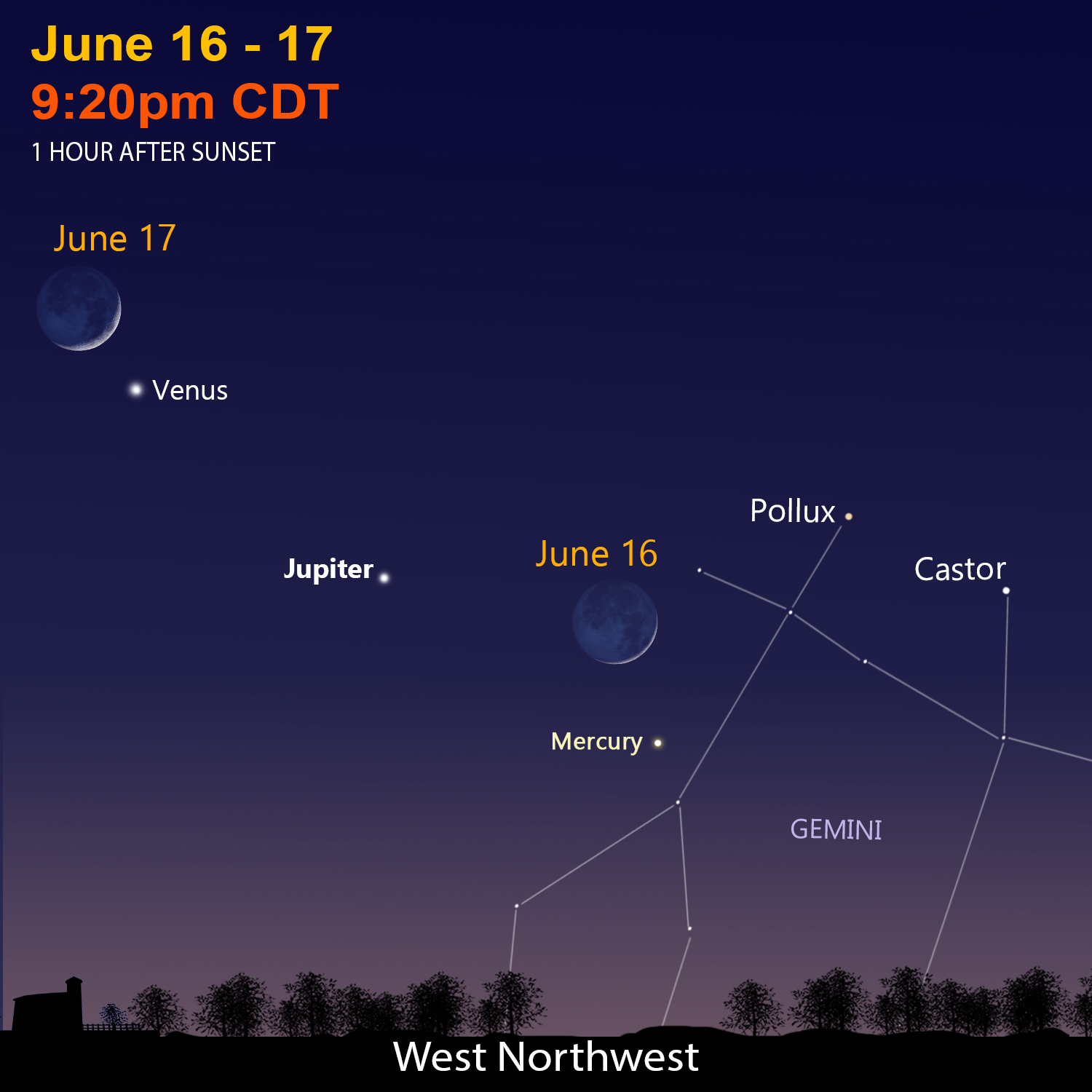
A crescent Moon returns to the evening skies and can be seen near Venus and Jupiter from June 16 to 17.
June Star Map
Sign Up
Receive this newsletter via email!
Subscribe
See the Universe through a telescope
Join one of the Milwaukee-area astronomy clubs and spot craters on the Moon, the rings of Saturn, the moons of Jupiter, and much more.
Follow Bob on social media
Twitter: @MPMPlanetarium
Facebook: Daniel M. Soref Planetarium